
Collection: José A. Vallejo I Of All Things.
JOSE ANTONIO VALLEJO SERRANO: SMILE, PLEASE.
By Javier Díaz-Guardiola*
I have known José Antonio Vallejo Serrano (Madrid, 1984) for years. I remember that when it happened and he started telling me about his working method, he confessed to me that, in a way, art helped him become the person he is today, it served as a refuge and helped him put a brave face on a childhood in which "bullying" took its toll for not being the heteronormative child some of his classmates expected. In a way, his ability to smile through everything rescued him with optimism and encouraged him to move forward without resentment.
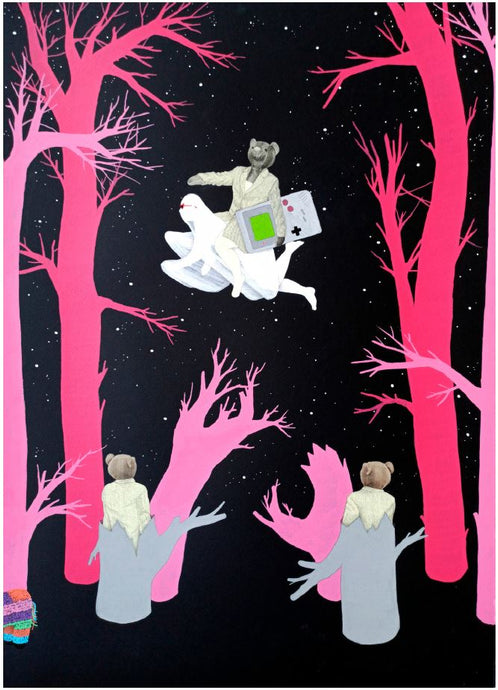
From that moment, we say, his imagination became populated with characters (three at the time: the teddy bear, the puppet, the inflatable) that, as "alter egos," served their author to analyze himself and provide simple answers, as a child would, to issues that affected him. He also gave rise to a plastic language (protagonists floating in his scenarios, a non-linear narrative, a fondness for colors like pink that proudly opposed the narrowness of blacks) that exuded mystery, lyricism, and hope in equal parts.
But in life, it's not all plain sailing. And no matter how conscientious one is or how much one likes to have everything tied down, there are things that cannot be controlled. The current exhibition at DDR is the result of overcoming grief; it deals with the need to talk about other issues besides the confirmation of an absence, to assume that a cycle (both temporal and in the artist's imagination) has been completed and that the creator needed to recover his voice, to refocus on himself, to talk about himself and his identity.
That's why the title of this exhibition is "of all things." From the phrase, "death is not the end of all things" (which reminds me of Cesáreo Gabaráin's military hymn). Eliminating the part that alludes to death, Vallejo keeps the second part, a more generic and even Platonic allusion. And, from there, the artist tries to recover everything that is lost when one experiences grief: joy, the desire to make plans, vitality... And even the overcoming of the grief of grief. Our protagonist confesses to me the feeling of discomfort and unease that floods one when one realizes that one is no longer feeling bad. And not only that: the paradox that there were people who got angry because he was feeling bad. Ultimately, feeling sad for being happy is outlandish, and these new drawings, especially the large format ones, have taught him to understand what was happening.
There are five works of these characteristics present in this exhibition, each one (and with the robot's permission, awaiting its own) more or less dedicated to a character, because throughout this time Vallejo has also grown as a person and the "alter egos" in which he unfolds his identity have multiplied. Although, as everything in his discourse, these mix, meet, relate, share ideas, while embracing new ones. Because the intention has not been so much to be rigorous with certain archetypes, but to re-establish them, "to love them again," to free them from the halo of sadness in which they were submerged in recent months.
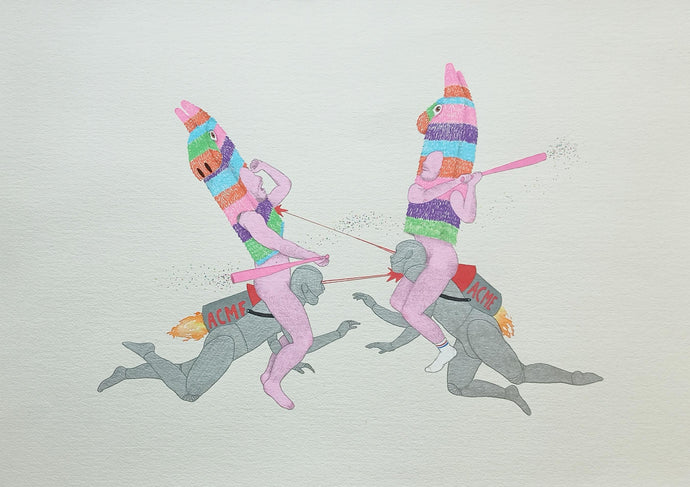
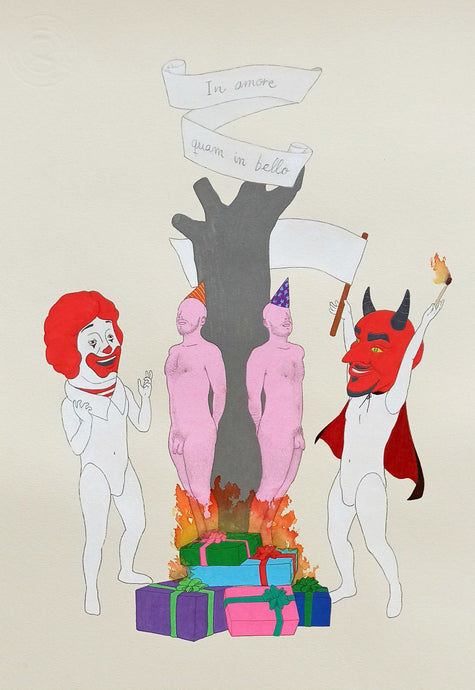
The characters now cross paths, and star in ambiguous scenes where, for example, explosions occur. It is difficult to understand what happens in them, with situations that cannot be controlled. In some, it is even difficult to determine if they begin or end, if the consequence is pleasant or painful... Issues that happen to the artist and are beyond his control are filtered in. And they can bring good or bad consequences. It is the anticipation before hitting a piñata, a recurring symbol for this author...
Stylistically, there are also changes. Vallejo has focused more on the settings in which his stories unfold. Having to feign happiness or show a way of being more in line with what was expected of him in this recent past led him to find in 1950s Hollywood movies a resource between reality and fiction that worked. Thus, in films like Irving Berlin's "There is no Business like Show Business" (1954), his spaces of happiness are full of stage design and give rise to very real pretenses. The stage machinery is visible but we don't care, we accept it. The painter's intention now is to return to himself not through pretense, but in a real way, and, for this, he places his characters in false sets that highlight the Madrid-born artist's dimension as a "builder."
In this way, if "Three Bears" could be the anchoring point between what came before and what is now arriving (this character used to be quite passive until today; a voyeur whose mission was to wait for us to go to bed and make our dreams sweeter), in "Nothing is Gonna Hurt you, Baby" the mysticism that has been present in Vallejo Serrano's work since the death of that relative who gave rise to the entire previous period makes its appearance. The long-sleeved character who stars in it is one of the first to become aware of the existence of others, around him, no longer isolated. His context is a forest in which they seem to organize themselves in some way, perhaps to start a ritual.
The puppet and the inflatable doll have always been two of Vallejo Serrano's favorite mirrors in which he saw himself reflected. The Egyptian perspective he recurrently used is replaced by the classical, as in "Funny Little Dolls" (how can one not see influences of Disney's short "Funny Little Bunnies," which is perverted in its final scene?). This is basic because in this new stage of "constructor," more and more elements are congregating on stage, many coming from his installations that will burst into the room in a second phase of the exhibition...
In Latin, 'Mors non est finis omnium rerum', is the work that titles the exhibition. Again, a large stage, constructed with waste or demolition material. It is no longer as baroque as before, but rather a kind of post-apocalyptic theater full of life in its ruin. "Gracias, Gracias, Gracias" remains to be mentioned, whose black background, after all that has been recounted so far, suggests that its message is not necessarily one of mourning.
As in previous appearances, the narrative in José Antonio Vallejo Serrano's proposal is fractured. Each of these "major drawings" (due to their scale) or his "minor drawings" (being smaller and more intimate) are small pieces of a puzzle without a fixed position in the narrative, perfectly fitting into the gap in memory that the viewer wishes to reserve for them. That's why we cannot tell if the proposed actions begin or end, if they are born or die, if they do not overlap each other, if their characters build or dismantle a plot, the order in which they succeed each other... As in "Listen carefully to the good news," it even seems suggestive to its author that they send contradictory messages (from the same piece or from several).
“I make the drawings I would have liked to see as a child,” he reminds me. Being a gay child created many insecurities in him. "En el camino hallarás compañía" ("On the way you will find company") is there, with a new layer of meaning now. Or "Ha vuelto a por ti, a por ti, a por ti..." ("He's back for you, for you, for you..."), which reaffirms that sadness or joy return; let's accept it and celebrate the good that comes from it. In "Una explosión, una fuerza descontrolada, un accidente" ("An explosion, an uncontrolled force, an accident"), with a marked disruptive and biographical accent, love prevails despite everything, even though his world is stirred and the trees bend with the wind. Finally, in "Y podrá volver a hacer el mal" ("And he can do evil again"), in which the characters grow in scale and therefore it is easier to discover the reference, the idea of constant reconstruction is evident...
All the works, deep down, are pages from a diary. And don't forget that it can be idealized or fantasized. Even so, they generate a script with advances and setbacks, with ambiguous situations, with a desire for self-improvement. Therefore, come what may, smile, please.
Valdenuño Fernández, October 11, 2025.
*Javier Díaz-Guardiola is a journalist specializing in contemporary art, critic and curator of exhibitions. He is currently coordinator of ABC Cultural, editor-in-chief of ABCdeARCO and author of the contemporary art blog “Siete de Un Golpe”.
-
- José A. Vallejo - Thank you, thank you, and thank you.
![- José A. Vallejo - Thank you, thank you, and thank you.]()

- Regular price
- €3,500.00
- Regular price
-
- Sale price
- €3,500.00
- Unit price
- per
- Availability
- Sold out
-
- José A. Vallejo - Three Bears.
![- José A. Vallejo - Three Bears.]()

- Regular price
- €3,000.00
- Regular price
-
- Sale price
- €3,000.00
- Unit price
- per
- Availability
- Sold out
-
- José A. Vallejo - Funny little dolls.
![- José A. Vallejo - Funny little dolls.]()

- Regular price
- €3,500.00
- Regular price
-
- Sale price
- €3,500.00
- Unit price
- per
- Availability
- Sold out
-
- José A. Vallejo - Death is not the end of all things.
![- José A. Vallejo - Death is not the end of all things.]()

- Regular price
- €3,500.00
- Regular price
-
- Sale price
- €3,500.00
- Unit price
- per
- Availability
- Sold out
-
- José A. Vallejo - Nothing’s gonna hurt you (maybe).
![- José A. Vallejo - Nothing’s gonna hurt you (maybe).]()

- Regular price
- €3,000.00
- Regular price
-
- Sale price
- €3,000.00
- Unit price
- per
- Availability
- Sold out
-
- José A. Vallejo - And you said something I'll never forget
![- José A. Vallejo - And you said something I'll never forget]()
- Regular price
- €1,200.00
- Regular price
-
- Sale price
- €1,200.00
- Unit price
- per
- Availability
- Sold out
-
- José A. Vallejo - Listen carefully to the good news!
![- José A. Vallejo - Listen carefully to the good news!]()

- Regular price
- €1,400.00
- Regular price
-
- Sale price
- €1,400.00
- Unit price
- per
- Availability
- Sold out
-
- José A. Vallejo - On the road, you'll find company.
![- José A. Vallejo - On the road, you'll find company.]()

- Regular price
- €1,400.00
- Regular price
-
- Sale price
- €1,400.00
- Unit price
- per
- Availability
- Sold out
-
- José A. Vallejo - An explosion, an uncontrolled force, an accident.
![- José A. Vallejo - An explosion, an uncontrolled force, an accident.]()

- Regular price
- €1,200.00
- Regular price
-
- Sale price
- €1,200.00
- Unit price
- per
- Availability
- Sold out
-
- José A. Vallejo - Nobody will silence this melody.
![- José A. Vallejo - Nobody will silence this melody.]()

- Regular price
- €1,200.00
- Regular price
-
- Sale price
- €1,200.00
- Unit price
- per
- Availability
- Sold out
-
- José A. Vallejo -…And he will be able to do evil again.
![- José A. Vallejo -…And he will be able to do evil again.]()

- Regular price
- €700.00
- Regular price
-
- Sale price
- €700.00
- Unit price
- per
- Availability
- Sold out
-
- José A. Vallejo - I'm back for you, for you, for you, for your soul and your heart.
![- José A. Vallejo - I'm back for you, for you, for you, for your soul and your heart.]()

- Regular price
- €650.00
- Regular price
-
- Sale price
- €650.00
- Unit price
- per
- Availability
- Sold out
-
- José A. Vallejo - Keep the love light glowing (Let me call you sweetheart).
![- José A. Vallejo - Keep the love light glowing (Let me call you sweetheart).]()
- Regular price
- €650.00
- Regular price
-
- Sale price
- €650.00
- Unit price
- per
- Availability
- Sold out
-
- José A. Vallejo - In amore quam in bello.
![- José A. Vallejo - In amore quam in bello.]()
- Regular price
- €600.00
- Regular price
-
- Sale price
- €600.00
- Unit price
- per
- Availability
- Sold out
-
- José A. Vallejo - What witches eat.
![- José A. Vallejo - What witches eat.]()

- Regular price
- €600.00
- Regular price
-
- Sale price
- €600.00
- Unit price
- per
- Availability
- Sold out
-
- José A. Vallejo - With each new birth they were closer to death.
![- José A. Vallejo - With each new birth they were closer to death.]()

- Regular price
- €450.00
- Regular price
-
- Sale price
- €450.00
- Unit price
- per
- Availability
- Sold out
-
- José A. Vallejo - (Flame)Das II.
![- José A. Vallejo - (Flame)Das II.]()

- Regular price
- €300.00
- Regular price
-
- Sale price
- €300.00
- Unit price
- per
- Availability
- Sold out


